US-Mexico shrimp farming startup Atarraya is preparing to pilot its high-tech production system in the United Arab Emirates as part of a broader strategy shift toward an asset-light partnership model, a move that could position the company at the center of food security efforts in the MENA region. The initiative, reported by AgFunderNews, comes as the company restructures operations, closes one US facility, and pivots to scaling through regional partners rather than owning farms directly.
Atarraya is working with Silal, a food security-focused company established by ADQ (Abu Dhabi Developmental Holding Company), to test whether its land-based shrimp production technology can be adapted to desert conditions. If successful, the pilot could lead to large-scale deployment aimed at supplying at least 5% of UAE shrimp demand.
The Gulf nation imports most of its shrimp despite having one of the highest per capita consumption rates globally. Authorities have recently explored domestic land-based production to reduce reliance on imports. According to Daniel Russek, founder and CEO of Atarraya, the UAE is seeking to accelerate the development of a broader shrimp industry rather than relying on a single supplier.
“The UAE has one of the highest per capita demands for shrimp, and they are not going to bet 100% on one company. They want to jumpstart the whole industry. And while most protein staples have low margins, shrimp farming is high margin. They also have very low energy costs,” Russek told AgFunderNews.
The discussions began more than two years ago, initially centered on Atarraya’s first-generation containerized production system. At that time, the economics were not viable for the Emirati partner. However, after the company introduced a lower-cost, flat-packed “air shrimp” tank design that significantly reduces capital expenditures, talks resumed and progressed into a detailed due diligence phase.
“They originally reached out to us when we had the first shrimp box model… and at that time the economics didn’t work for them,” Russek explained. “But they reached back out once we announced the new version and we started with very deep due diligence last February.”
Business model overhaul
The UAE project coincides with a structural transformation at Atarraya. While the company continues producing shrimp in Mexico, it has shut down its Indianapolis facility and will convert its New Jersey site into a processing hub and demonstration center.
Russek acknowledged that the traditional venture capital model proved incompatible with a capital-intensive food production business. “We’ve got to the stage where we’ve de-risked the technology and checked the boxes on stabilizing the biology, predictability, feed conversion ratios, and productivity per hectare,” he said.
However, he added: “We need funding to scale up to reach profitability, and I think we can confidently say the tech VC match doesn’t work well for food; it’s like fitting a square peg into a round hole. We have software but we are not just a SaaS company. You can’t build a shrimp farm on ChatGPT. Aquaculture operates in biological times, not software timelines.”
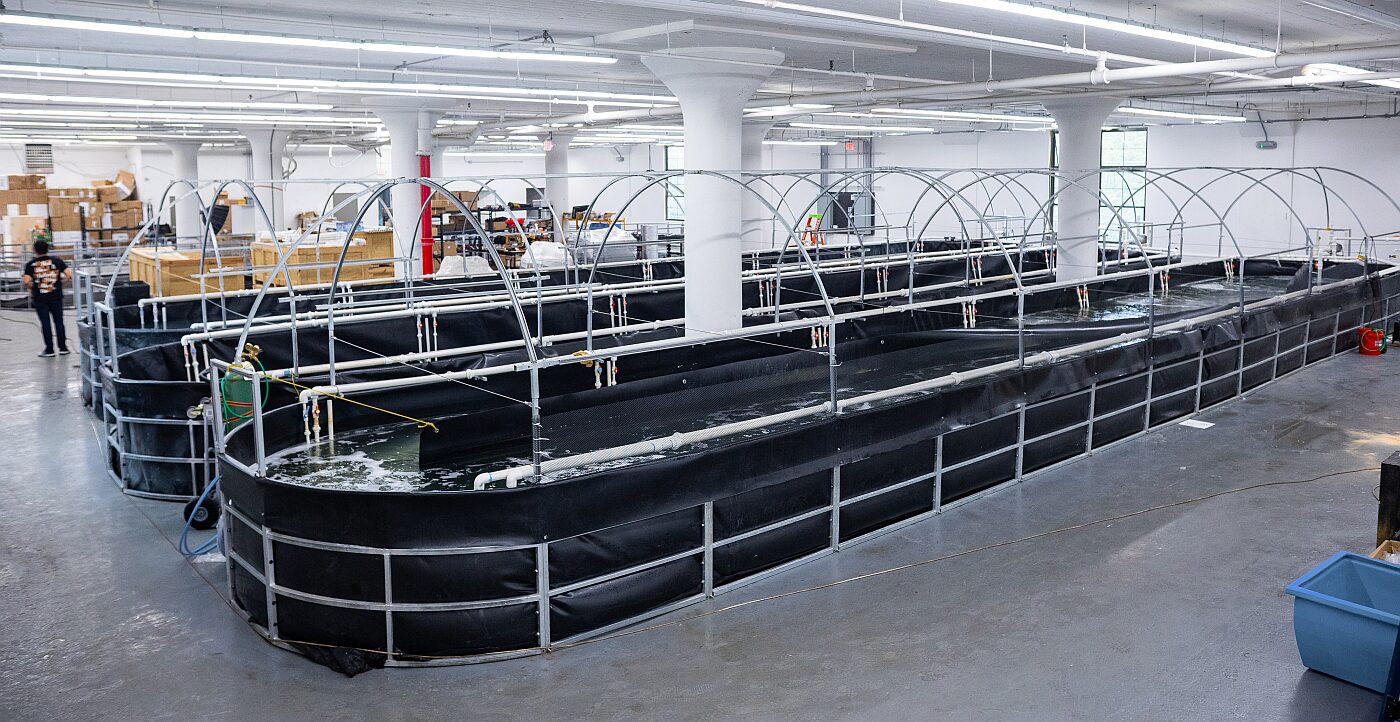
The company has reduced capital requirements by 70% with the redesigned tanks and is now focusing on partnerships with what Russek describes as “master franchisors” in key regions. These partners would finance and operate farms, while Atarraya provides technology, operational support and market access.
“If you buy a farm from us, for two seasons, for two cycles, we will be responsible for achieving the KPIs. And then we will do the handoff,” Russek said.
Shrimp and tomatoes under one roof
As part of its scaling strategy, Atarraya is also exploring co-location opportunities with greenhouse tomato producers, particularly near affluent metropolitan areas. Shrimp and tomatoes require similar temperature ranges, around 26–28°C, which allows shared infrastructure.
The company argues that integrating shrimp tanks into existing greenhouses could increase profitability per hectare while leveraging existing permits, utilities and energy systems. In addition, the microbial biomass, or biofloc, generated in shrimp tanks can be processed into organic fertilizer.
“We got a grant from the Rockefeller Foundation in 2024 to see if our biofloc could be a more effective fertilizer than the commercial fertilizer and the answer was a resounding yes for tomatoes and corn,” Russek stated.
Technology and sustainability focus
Atarraya’s production system relies on biofloc technology, cultivating microbial communities that help regulate water quality and convert nitrogen compounds into biomass. The resulting microbial matter can be removed and reused as fertilizer.
The redesigned “air shrimp” tanks, which combine steel frames with fiberglass and plastic components, are lighter and easier to transport than the company’s earlier rigid container-style systems. Air pumps maintain oxygen levels, while proprietary software monitors pH, salinity, ammonia, nitrites, nitrates and biomass estimates.
Russek argues that the system offers an alternative to coastal shrimp farming, which has faced criticism over environmental damage, pollution and labor practices. Land-based systems also reduce exposure to disease and extreme weather.
With the UAE pilot set to determine its next phase of expansion, Atarraya is betting that a partnership-driven, lower-capex model can align technological innovation with the financial realities of global food production.