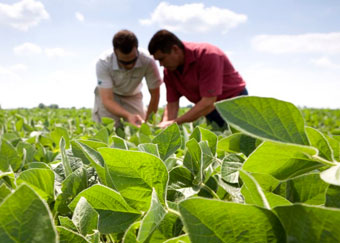
China is accelerating a new phase of agrifood investment driven by strong state involvement, large-scale infrastructure, and policy-backed capital, reshaping how innovation is financed and scaled across food and agriculture. According to information reported by AgFunderNews, this strategy is positioning the country as one of the most dynamic agrifoodtech ecosystems globally, even as investment slows in other regions.
The shift is taking place across multiple provinces and industrial clusters, where public policy, capital deployment, and private execution are aligned around national priorities such as food security, biomanufacturing, and technological self-reliance. The result is a model in which the state plays an active role in de-risking innovation, enabling companies to move faster from pilot stages to commercial scale.
State priorities redefine the agrifood investment playbook
China’s agrifood strategy is increasingly shaped by geopolitical pressures and the need to secure critical resources and technologies. In this context, investment decisions are no longer driven solely by novelty or disruption, but by a company’s ability to address strategic bottlenecks in priority sectors.
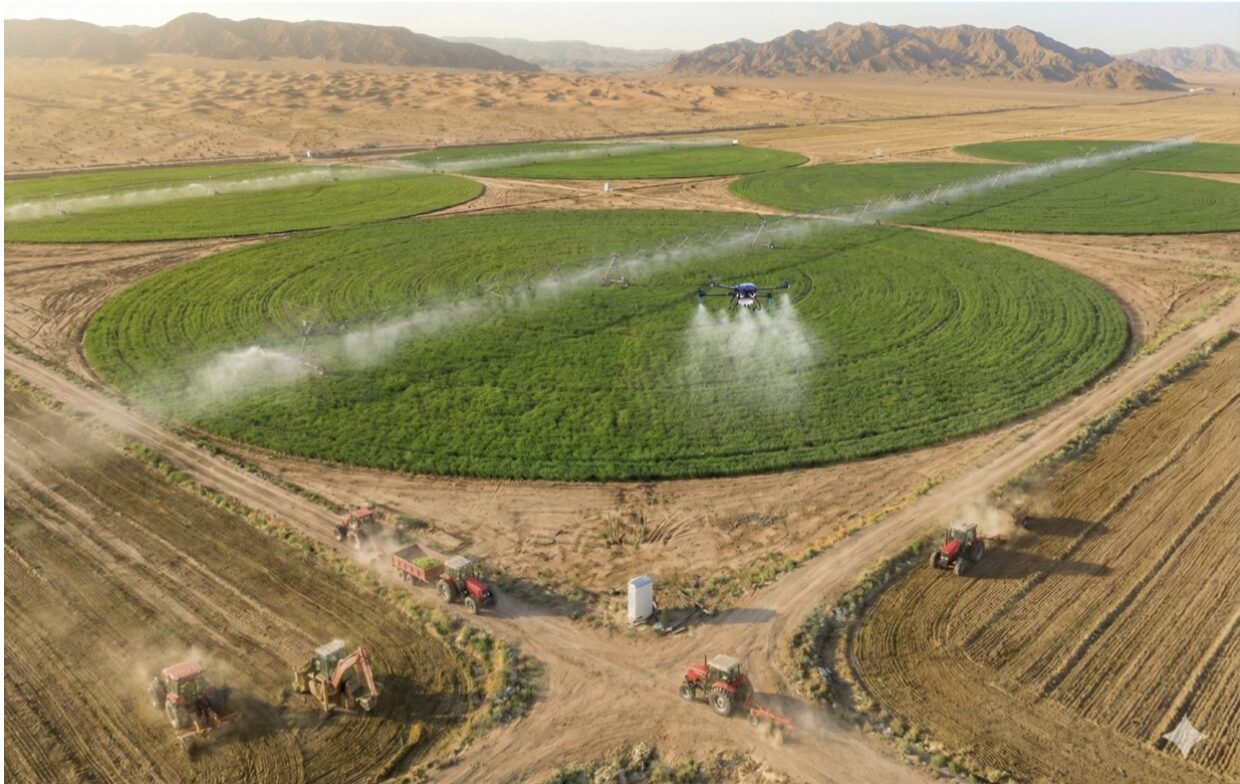
Agriculture stands at the center of this agenda. Over the past decade, China has invested hundreds of billions of renminbi in the development of high-standard farmland, covering more than 1 billion mu (approximately 67 million hectares). These investments have upgraded irrigation, soil quality, and digital infrastructure, creating a large-scale testing ground for precision agriculture, automation, and data-driven farming systems.
With these foundations in place, farming practices are shifting from experience-based decisions to technologies such as smart irrigation, autonomous field operations, and drone-based crop monitoring. This environment has enabled agritech companies to validate solutions rapidly and scale across diverse climates and geographies.
One example cited by AgFunderNews is EAVision, an agricultural drone company that tested its technology across China’s varied terrain before expanding internationally. The company’s growth reflects how domestic scale and policy alignment can support global competitiveness.
Biomanufacturing gains momentum through industrial scale
The same model is reshaping China’s biomanufacturing sector, which has emerged as a core engine of the country’s bioeconomy. While many synthetic biology startups globally struggle to move beyond pilot production due to high costs and infrastructure gaps, China offers structural advantages.
The country accounts for more than 70% of global fermentation capacity, supported by integrated supply chains, experienced industrial operators, and a deep pool of scientific and engineering talent. These conditions reduce the cost and risk of scaling biomanufacturing processes, enabling faster commercialization.
AgFunderNews reports that companies such as Cataya Bio are leveraging these advantages by building commercial-scale facilities within specialized industrial parks. In provinces like Jiangsu, dedicated synthetic biology zones provide supportive policies, utilities, and financing mechanisms that shorten the path from laboratory research to market-ready production.
Capital markets regain momentum
After a period of tight liquidity, China’s capital markets are showing renewed activity following a series of government stimulus measures and debt-resolution initiatives. These actions have restored investor confidence and increased risk appetite, particularly in high-technology sectors.
Public markets have been a key indicator of this rebound. Since 2025, domestic equity markets have benefited from policy tailwinds and high-profile technological breakthroughs. Market capitalization in mainland exchanges surpassed RMB 100 trillion, while Hong Kong reclaimed its position as a leading global IPO venue.
Regulatory reforms have also played a role. Adjustments to the STAR Market and HKEX Chapter 18C have enabled pre-profit technology companies to access public listings, opening new exit pathways for venture investors. Several technology firms achieved significant valuation gains following these reforms, reinforcing confidence in China’s innovation pipeline.
Government funds step in as market makers
Beyond IPOs, government-backed investment vehicles are increasingly filling funding gaps for growth-stage companies. These funds provide long-term capital aligned with national priorities, allowing startups to scale without relying solely on private venture funding.
According to AgFunderNews, this approach has facilitated exits for early investors while ensuring that capital-intensive expansion remains domestically anchored. In some cases, provincial government-backed funds have acquired stakes in companies after early-stage validation, taking over the scale-up phase and aligning corporate growth with regional development goals.

This model has been replicated across multiple agrifood and biotechnology ventures, with government participation supporting successive growth rounds and stabilizing financing conditions.
M&A activity strengthens industrial integration
China’s evolving investment framework is also reflected in a surge of mergers and acquisitions. Recent regulatory measures aimed at encouraging industrial consolidation have expanded M&A activity, particularly among listed companies seeking technology upgrades or strategic assets.
In 2025 alone, more than 1,000 M&A transactions were recorded on the Shanghai Stock Exchange, with major restructurings rising sharply year over year. Agrifood has been an active segment of this trend, as companies pursue vertical integration and technological strengthening across seeds, protein production, and supply chains.
Public capital, private execution
A defining feature of China’s current agrifood investment model is the growing role of public-private partnerships. Rather than acting solely as a subsidy provider, the state increasingly functions as an ecosystem builder, deploying capital through fund-of-funds structures managed by professional investors.
Large-scale guidance funds launched by national and provincial authorities signal a long-term commitment to frontier technologies, including biomanufacturing, agritech, and food system innovation. These funds typically operate on extended timelines, aligning with the long development cycles of deep technology.
For private investors, this structure offers access to patient capital while preserving operational independence. The combination of public stability and private-sector execution is reshaping how agrifood innovation is financed and scaled in China.
A distinct path forward
As global investors reassess China’s role in technology and food systems, the agrifood sector illustrates a broader shift. The country is no longer pursuing imitation-based growth but is building specialized industrial capabilities rooted in scale, speed, and integration.
The alignment between state strategy and market forces is enabling China to advance innovation even amid global uncertainty. For companies and investors willing to engage with this model, the opportunity lies not only in market access, but in participating directly in the infrastructure and systems shaping the future of food.