According to AgFunderNews, Peter McGuinness will step down as chief executive officer of Impossible Foods at the end of January 2026, closing nearly four years at the helm of the US-based plant-based food company. The transition will take place in San Francisco, where the company is headquartered, and is relevant as it comes amid sustained pressure on the alternative protein sector, slowing retail sales, and growing demands from investors seeking returns on record levels of funding.
McGuinness will gradually wrap up his day-to-day responsibilities over the next few weeks but will remain involved with the company as a member of its board of directors, according to people familiar with the matter cited by AgFunderNews. His operational duties will be divided among senior executives: Jason Gao, chief legal and operating officer; Meredith Madden, chief demand officer; and Robert Haas, chief supply officer. A company spokesperson declined to say whether Impossible Foods plans to appoint a new CEO in the near future.
In a statement released by the company, Impossible Foods framed the leadership change as a planned transition. “I’m proud of the position Impossible is in today and I’m very confident in the company,” McGuinness said, according to the press release cited by AgFunderNews. The company described the move as a transition “from a position of strength,” highlighting performance that it says exceeded the broader plant-based category in the United States.
Under McGuinness’s leadership, Impossible Foods focused on consolidating its position in core categories rather than expanding aggressively into adjacent products. The company reported gains in innovation, distribution, and demand creation, reaching the number two spot in US market share for plant-based meat, behind MorningStar Farms, according to figures shared in the release. While Impossible Foods did not disclose revenue or sales data, it confirmed that it has maintained long-standing partnerships with major foodservice and retail customers, including Burger King and Starbucks.
Industry sources quoted by AgFunderNews said McGuinness played a central role in repositioning Impossible Foods from a foodtech startup toward a more traditional, tech-enabled CPG (consumer packaged goods) company. That shift included scaling back research projects in areas such as plant-based seafood, eggs, and milk, and concentrating resources on its core beef, chicken, and pork alternatives. The strategy also involved updated packaging, with a move toward bolder red branding, and a marketing focus on taste and nutrition rather than messaging centered on replacing animal agriculture.
Most recently, Impossible Foods partnered with Equii, a startup that uses fermentation to produce grains with higher protein content, to develop new bread and pasta products. The collaboration reflects the company’s effort to extend its technology into adjacent food categories while staying close to mainstream consumer preferences.
Despite these moves, McGuinness’s tenure coincided with a period of mounting headwinds for the plant-based meat industry. Retail sales growth slowed significantly after the pandemic-era surge, while inflation, supply chain pressures, and changing consumer behavior weighed on performance. Negative media coverage and investor skepticism further complicated the outlook for companies in the sector.
One alternative protein industry source told AgFunderNews that McGuinness faced an unusually difficult environment. “I think he has done a great job at trying to steer the ship in a very difficult market,” the source said, adding that Impossible Foods, like several peers, raised large sums of capital at valuations that would be difficult to justify under public-market scrutiny. According to the same source, expectations tied to valuation milestones may have become increasingly unrealistic as category growth slowed.
Another industry insider was more blunt, saying: “No one is doing well in this category, or not well enough to make ends meet with the massive expectations and expense structure designed to be a billions-of-dollars company.” The source added that Impossible Foods’ growth in US retail had been driven primarily by expanded distribution rather than sustained increases in sales per store, a dynamic that raises questions about long-term scalability.
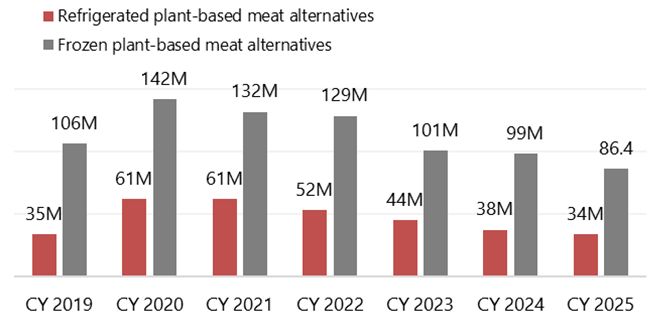
Data cited by AgFunderNews underscores those concerns. According to figures from Circana, analyzed by 210 Analytics, sales of refrigerated plant-based meat alternatives in conventional US retail channels have declined steadily since the third quarter of 2021. Dollar sales fell from about $490 million in 2021 to $276 million in 2025, returning the category to roughly its 2019 level. Frozen plant-based products, which accounted for 68% of category sales in December 2025, have also seen declines, though less severe.
Geographically, Impossible Foods has taken a more cautious approach to international expansion than some competitors. While Beyond Meat invested heavily in China before suspending operations there, Impossible Foods has focused primarily on the US market, with limited sales in Canada, Australia, New Zealand, Singapore, the United Arab Emirates, Hong Kong, and Macau. In the United Kingdom, the company continues to await regulatory approval for its signature heme protein, though it has sold plant-based chicken products without heme since 2022. Progress toward broader European Union market entry has been described as significant but remains incomplete.
Looking ahead, the leadership transition leaves Impossible Foods at a strategic crossroads. The company remains privately held and insulated from some of the pressures facing publicly traded rivals, but expectations from investors who have poured nearly $2 billion into the business over the past 15 years remain high. Whether the shared leadership structure becomes permanent or gives way to a new CEO appointment will likely signal how the company plans to navigate the next phase of a still-evolving market.
As McGuinness steps back from daily management, Impossible Foods faces the challenge of stabilizing growth, adapting to changing consumer demand, and proving that the plant-based meat model can deliver sustainable returns in a more cautious investment climate.