Brilliant Harvest, a US agtech startup specializing in artificial intelligence for agricultural equipment service, has raised $4 million in seed funding to expand its AI-powered helpdesk platform, aimed at reducing service bottlenecks for dealers and improving response times for farmers. The round, completed in early 2026, supports the company’s growth strategy in North America at a time when dealerships face mounting operational pressure from labor shortages and increasingly complex equipment ecosystems. The funding and business milestones were reported by AgFunderNews.
Founded by industry veteran Remi Schmaltz, Brilliant Harvest develops a white-label AI assistant designed for agricultural equipment dealers. The platform centralizes fragmented data sources—such as work orders, dealer-specific knowledge bases, ERP systems and extensive technical manuals—and delivers real-time answers to service-related questions from customers, technicians and internal teams. The goal is to streamline workflows that traditionally depend on manual searches across disconnected systems.
The seed round was backed by new investors FTW Ventures, Alpaca VC, Automotive Ventures, SVG Ventures and NYA Ventures, alongside existing backers Builders VC and AltaML. The capital raise follows a period of strong commercial traction, including multi-year contract renewals with Rocky Mountain Equipment and Titan Machinery, and a significant expansion within CNH, which now offers the platform at roughly half of its large dealer locations.
According to the company, the relevance of the solution lies in the growing complexity of modern agricultural machinery and the service networks that support it. Equipment dealers typically manage dozens of brands, each with its own manuals, software platforms and service protocols. When customers call or visit with questions, staff often need to consult multiple systems—ranging from ERP software to manufacturer portals—to find accurate information, a process that can take significant time and delay service resolution.
Schmaltz has argued that while direct interaction with experienced staff remains ideal, it is not always feasible. Skilled technicians are not available around the clock, and even seasoned employees may struggle to retrieve accurate answers quickly when information is scattered across systems. By contrast, the Brilliant Harvest assistant can analyze thousands of pages of documentation and historical interactions in seconds, delivering responses grounded in the dealer’s own data.
The platform is fully branded for each dealership and operates as both a mobile app and a web-based interface. It is designed to complement, rather than replace, existing ERP and CRM systems. The company reports that deployment can be completed in under 30 days for dealers already using major industry ERPs such as DIS, IntelliDealer and e-Emphasys, as well as for brands it already supports, including CNH, Kubota and AGCO.
From a business perspective, the value proposition centers on efficiency and measurable financial returns. Early data cited by the company suggest that around 70% of questions handled by dealerships relate to work orders or short-line brands, while only 30% involve mainline OEM manuals. By deflecting routine, low-value inquiries away from phone calls and manual searches, dealerships can free technicians to focus on billable work.
Investors have highlighted this aspect as a key differentiator. Steve Greenfield, general partner at Automotive Ventures, said the company has addressed what he described as a persistent challenge in the sector: service teams overwhelmed by routine inquiries that erode productivity. By enabling first-contact resolution through AI, the platform aims to improve service absorption rates while enhancing the customer experience.
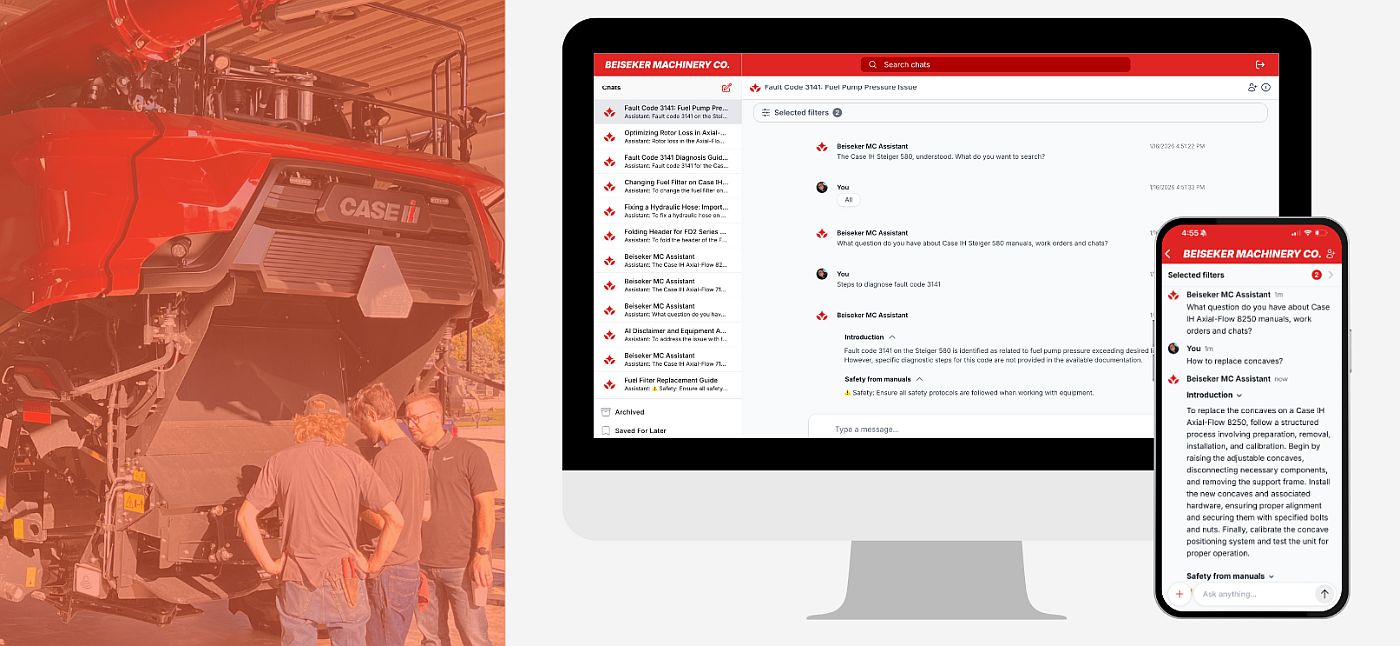
A central element of Brilliant Harvest’s approach is its Human-in-the-Loop (HITL) verification layer, which is designed to mitigate concerns around AI accuracy. Rather than relying on generalized language models, the system ingests only verified “ground truth” data from a dealer’s own manuals, ERP records and conversational history. Human oversight is used to validate and structure information before it becomes part of the AI’s response framework, a process intended to ensure both accuracy and equipment safety.
This emphasis on reliability addresses a broader skepticism toward AI within the industry, often driven by experiences with generic tools that can produce hallucinated or unverifiable answers. Schmaltz has positioned the platform as a pragmatic application of AI, focused on narrow, high-impact use cases rather than broad automation.
Beyond efficiency gains, the company frames its technology as a response to a structural talent shortage in equipment dealerships. High turnover and difficulty recruiting experienced technicians mean that institutional knowledge is often fragmented or lost. By capturing and organizing that knowledge digitally, the platform allows less experienced staff to access insights typically accumulated over many years, effectively shortening the learning curve.
While the solution can be used by single-location dealers, Brilliant Harvest identifies its primary market as enterprises operating between three and 100 locations, servicing more than 20 brands. These organizations face the greatest operational complexity and the highest costs associated with service delays and information gaps.
With the new funding, Brilliant Harvest plans to continue scaling its platform across North America, deepen integrations with dealer systems and expand its sales and customer success teams. As agricultural equipment continues to incorporate more advanced technology, the company is positioning itself as an infrastructure layer that helps service organizations keep pace—by turning fragmented data into actionable, real-time support.