Polybee raises $4.3 million to scale AI-driven pollination and yield forecasting
The Singapore-based agtech startup will expand its autonomous drone technology across greenhouses and open fields, targeting more than 4,000 acres in 2026
Polybee, a Singapore-based agtech startup, has raised $4.3 million in seed funding to accelerate the deployment of its AI-powered pollination and yield forecasting technology, delivered through fleets of autonomous drones operating in greenhouses and open-field crops. The round was led by Paspalis Capital and elev8 VC, with participation from SEEDS Capital and strategic angel investors, including Jorge Heraud, founder of Blue River Technology. The funding is aimed at supporting a fivefold expansion of Polybee’s operations to more than 4,000 acres by 2026, underscoring the growing relevance of automation and data-driven decision-making in agriculture.
Founded in 2019 by Siddharth Jadhav, Polybee develops what it describes as “physical AI agents”: small, self-recharging drones equipped with cameras and onboard intelligence that continuously monitor crop health, ripeness and variability. The system generates AI-based yield forecasts that help growers determine optimal harvest timing, improve planning accuracy and increase profitability.
“We have unequivocal evidence by now that if our recommendations and predictions are followed, you get higher yields compared to growers’ own decision making,” Jadhav said. “This has been proven across multiple regions, across seasons, and varieties.”
Beyond forecasting, Polybee’s drones are also used for autonomous pollination in greenhouse environments. Using patented controlled-airflow technology, the drones transfer pollen within self-pollinating crops such as tomatoes, strawberries and blueberries, reducing reliance on bumblebees and manual labor. According to Jadhav, this capability allows growers to maximize fruit set during shoulder seasons, when market prices tend to be higher.
“In some of these glasshouses in Australia, pollination is a hair-on-fire issue; they’ve got people working for hours every day just whacking the plants with a stick,” he explained. “But even in places where you have bumblebees, they are exploring our solution because first, it’s more consistent, and second, you’re de-risking the spread of certain pathogens from bumblebees to the crops.”
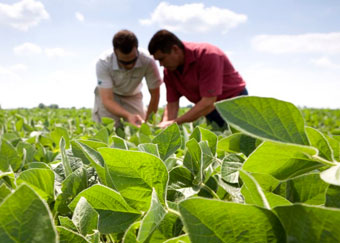
Polybee reports that its technology has delivered measurable economic impact across different crops and geographies. Case studies in baby leaf spinach and broccoli show up to threefold profit improvements, driven by optimized harvest timing and early stress detection. In greenhouse crops, autonomous pollination has resulted in yield increases of up to 15%, alongside savings from reduced manual scouting and improved negotiating power with buyers.
“Instincts don’t scale, and neither does eyeballing a thousand hectares,” Jadhav said, highlighting the limits of traditional crop assessment methods in large-scale operations. “If you want to make an accurate forecast, you need to capture variability, which is such an inherent part of fresh produce.”
The company has already secured commercial contracts with major greenhouse producers in Australia, large fresh produce growers in the United States, and the UK’s second-largest greenhouse berry producer. While Polybee currently deploys its software on off-the-shelf drones, its platform is designed to be hardware agnostic, provided the drones can self-launch and self-recharge without human intervention.
Polybee operates under a subscription-based business model, charging a fixed fee per hectare. Growers do not need to purchase the drones upfront, as the service includes hardware, software access and field support.
Looking ahead, the company plans to deepen its capabilities in crop stress and disease detection through advanced imaging. While multispectral cameras are already being tested, Polybee is working with manufacturers to integrate these sensors into its autonomous docking drones, enabling more detailed diagnostics using the same hardware platform.
“The technology works; now we scale,” Jadhav said, summarizing the company’s next phase as it positions itself at the intersection of artificial intelligence, robotics and modern agriculture.
Invertí en periodismo de calidad
En Agroempresario trabajamos para acercarte contenidos que agregan valor.