By Agroempresario.com
Onego Bio, which had previously announced a $40 million series A round in April, has raised a total of $70.8 million to date. The company uses a genetically engineered strain of fungus to express ovalbumin, the most prevalent protein in egg whites, under the brand name ‘Bioalbumen.’
While other startups like The EVERY Co produce ovalbumin from yeast strains, Onego Bio utilizes the fungus Trichoderma reesei, which it claims delivers superior titers and yields.
The company is on track to achieve self-affirmed GRAS (Generally Recognized as Safe) status this year and plans to submit this determination to the FDA, hoping to secure a ‘no questions’ letter in 2025. Onego Bio is also preparing a Novel Foods submission to EFSA to enter the EU market.

Onego Bio, with commercial operations in San Diego, was one of 68 companies selected from 969 startups to receive funding from the EIC Accelerator, which seeks high-impact, scalable products, services, or business models that can create new markets or disrupt existing ones.
Founded in 2022 as a spinoff from VTT (Technical Research Center of Finland), Onego Bio is scaling up production with co-manufacturers while finalizing plans for in-house manufacturing. The company is collaborating with leading food companies in various sectors, including baked goods, confectionery, snacks, sauces, pasta, and meat alternatives.
A single full-scale manufacturing unit of Onego Bio will have a two-million-liter fermentation capacity, effectively delivering the protein equivalent of six million laying hens.
The market for animal-free egg proteins remains robust despite a cooling off in some parts of the alternative protein category. According to Onego Bio cofounder and CEO Maija Itkonen, food manufacturers have long sought viable egg replacements due to price fluctuations and supply issues caused by avian flu outbreaks. Companies are interested in egg proteins made without chickens not just for environmental reasons but also for their functionality and clean label credentials.
Itkonen, an industrial designer who entered the food industry in 2015 after cofounding plant-based meat firm Gold & Green, explained that the environmental benefits help companies futureproof their supply chains amid increasing environmental regulations. However, the primary drivers of demand for animal-free egg proteins are the shortage of cage-free eggs and the volatility caused by avian flu.
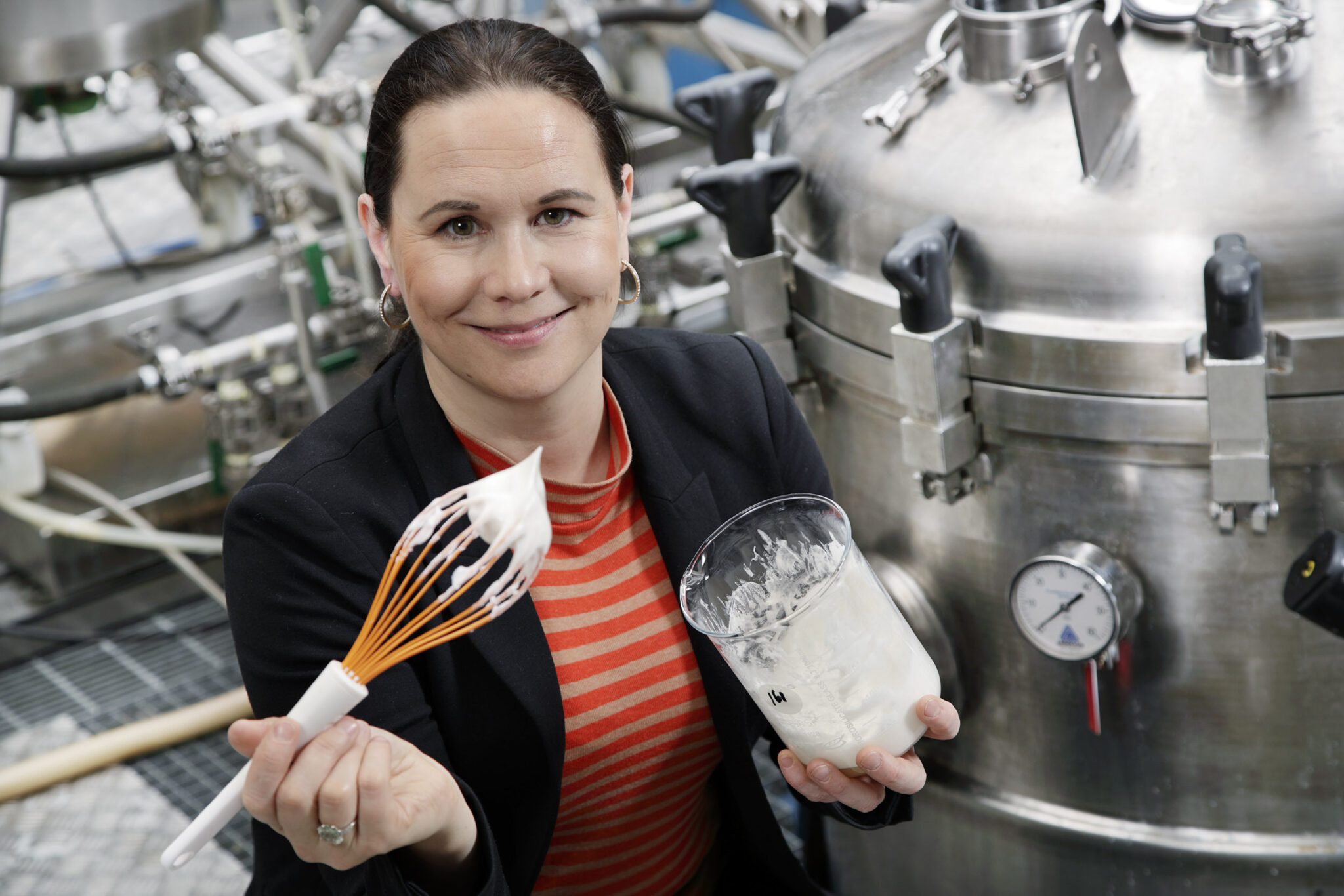
Although Onego Bio is currently producing only ovalbumin, it can replace eggs in many applications, offering functional properties such as aeration, whipping, gelling, binding, and foam stability. Trials with food manufacturers in bakery, confectionery, snacks, and other products have been very successful.
Itkonen noted that while there are pros and cons to any microbial host, high titers are not useful if productivity and yield figures are poor. Onego Bio is achieving titers of 60, 80, and 100g per liter while maintaining good yields and is continuously improving.
Onego Bio is working with co-manufacturers to perfect its process before building its own facilities. Itkonen emphasized the importance of doing things in stages and plans to start building their factory in a few years to meet the massive volumes needed by the egg industry and achieve cost parity.
This year, Onego Bio will have volumes for big trials, with larger market activities expected to start next year.

The landscape for animal-free egg proteins is currently dominated by The EVERY Co and Onego Bio. The EVERY Co recently partnered with Grupo Palacios to incorporate its liquid egg alternative into Spanish omelets and with Unilever-owned brand The Vegetarian Butcher for selected meat alternatives.
Onego Bio continues to advance in this space, providing a sustainable and functional alternative to traditional egg proteins.