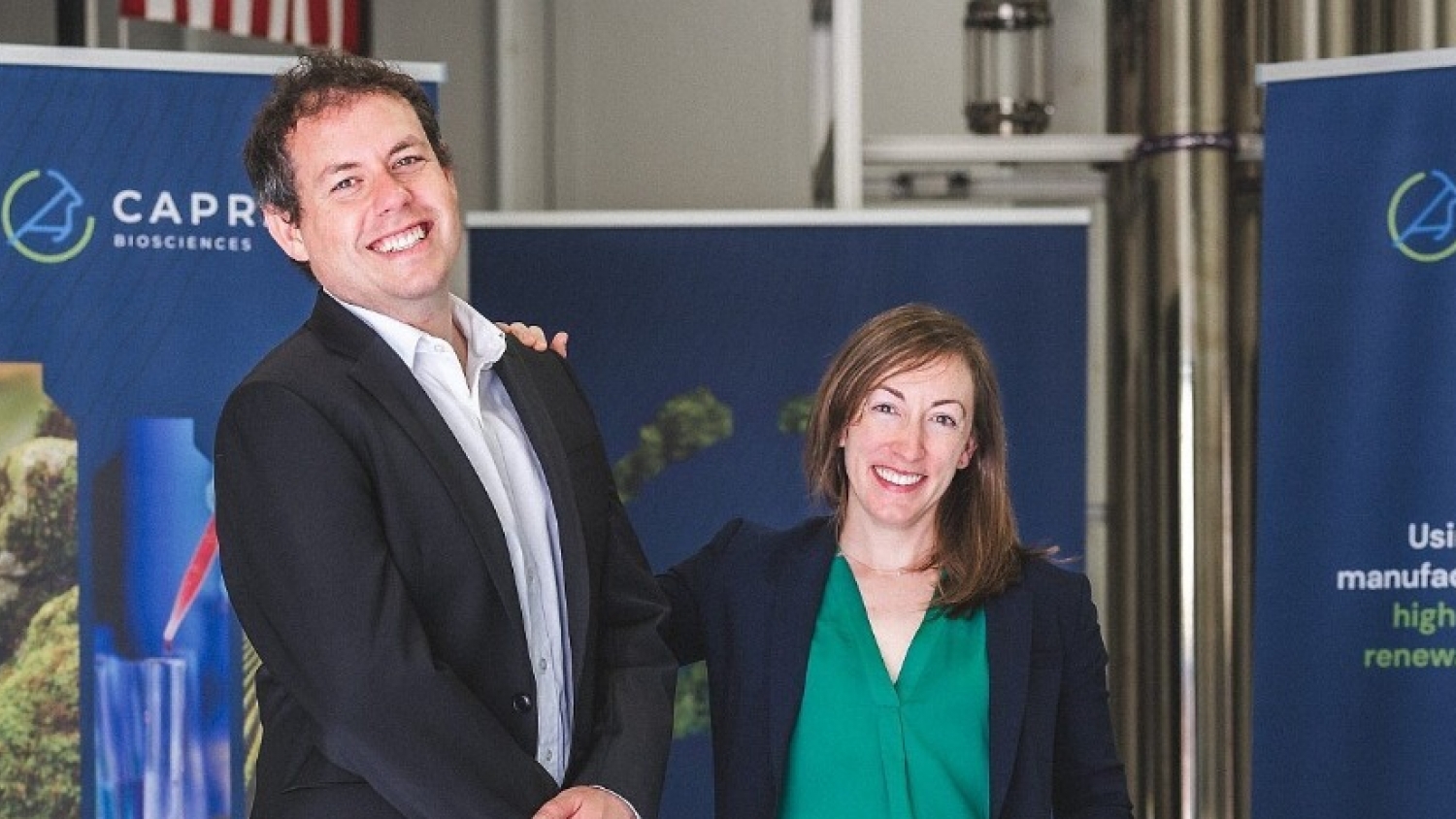
US startup Capra Biosciences is developing a new generation of wireless biosensors designed to optimize fermentation processes, reduce production costs and improve efficiency in the growing biomanufacturing industry. The company, based in Virginia, is working alongside Boston University on the project, which could help biotechnology compete more directly with petrochemical manufacturing, according to AgFunderNews.
The sensors, which researchers say could eventually be as small as a chickpea, are designed to float freely inside bioreactors and continuously monitor critical fermentation conditions in real time.
The project combines engineered microbes, electronics and wireless communication systems to create a new type of monitoring platform for industrial fermentation.
According to AgFunderNews, Capra Biosciences specializes in producing retinol and other high-value ingredients through biomanufacturing using microbes fed with industrial byproducts such as glycerol and thin stillage.
The company’s production model differs from traditional large fermentation tanks. Instead, it operates with multiple modular 1,000-liter units that allow continuous fermentation processes.
Capra CTO Andrew Magyar explained that sensor technology could become a decisive factor in making biomanufacturing economically competitive on a global scale.
“For biomanufacturing to be really competitive with petrochemical manufacturing on a global scale, sensor technologies that allow us to run more efficiently are really going to be differentiating,” he told AgFunderNews.

The biosensors are designed to monitor pH levels, dissolved oxygen, cellular stress, metabolic activity, media composition and electrochemical signals.
Unlike conventional probes, which are inserted into tanks and can increase contamination risks, the new sensors can float inside the fermentation broth and provide data from multiple points simultaneously.
The technology also integrates AI-powered analytics. Capra uses its own internal manufacturing execution and data systems to compare information from traditional probes and the new wireless devices in real time.
Magyar said the goal is to make the sensors dramatically cheaper than conventional industrial probes, which can cost between $5,000 and $10,000 each.
“The biosensors could eventually be as small as maybe say a chickpea,” he said. “When produced at scale, this would be massively less expensive than the probes used in traditional biomanufacturing.”
The company believes lower sensing costs are especially important for modular production systems that may operate hundreds or even thousands of reactors within a single facility.
According to AgFunderNews, the project is supported by the National Science Foundation and BioMADE, a US public-private initiative focused on advancing bioindustrial manufacturing technologies.
The research team includes Miguel Jimenez from Boston University, who is engineering microbial cells for the sensors, and Rabia Yazicigil, who is developing semiconductor chips capable of reading optical signals and wirelessly transmitting data.
Capra says the platform could eventually expand beyond biomanufacturing into sectors such as environmental monitoring, wastewater treatment, industrial process control and pharmaceutical manufacturing.
Another major focus for the startup is replacing petrochemical-derived ingredients with biologically produced alternatives.
Capra recently launched a bio-manufactured salicylic acid for personal care applications. According to Magyar, the product avoids residual phenol contamination commonly associated with petroleum-derived salicylic acid.
The company is also scaling production of fermentation-derived retinol using its modular reactor system.
Magyar said global supply chain disruptions in recent years have strengthened interest in domestic biotechnology manufacturing.
“We see biotechnology as a really powerful way to bring back chemical manufacturing to the US,” he told AgFunderNews.
The startup believes technologies that reduce operational costs and improve monitoring precision could accelerate adoption of biomanufacturing across multiple industries.