Bonsai Robotics uses AI to cut farm costs and automate tasks
The California startup combines computer vision and autonomous machinery to reduce labor, fuel and equipment costs across specialty crops
jueves 03 de septiembre de 2026 - 08:00
Bonsai Robotics is expanding an artificial intelligence platform designed to make autonomous farm machinery more flexible and less expensive to operate across orchards, vineyards, berries and other specialty crops. The California-based company uses computer vision to transform 2D camera images into a scaled 3D understanding of farm environments, allowing the same autonomy system to work across different crops without rebuilding the software for each application, according to AgFunderNews.
The strategy addresses one of the long-standing challenges in agricultural robotics: machines have traditionally been designed either for one highly specific task or with greater flexibility that often adds cost and technical complexity.
Bonsai wants to change that equation through a vision-based autonomy stack that can be installed on existing tractors and other equipment while also powering machines developed by the company itself.
The business expanded its hardware capabilities after acquiring Farm-ng, whose Amiga platform is now being developed into larger machines for spraying, hauling and lifting. The goal is not simply to replace workers, but to reduce the overall cost of agricultural operations through lower capital expenditure, fuel consumption and operating expenses.
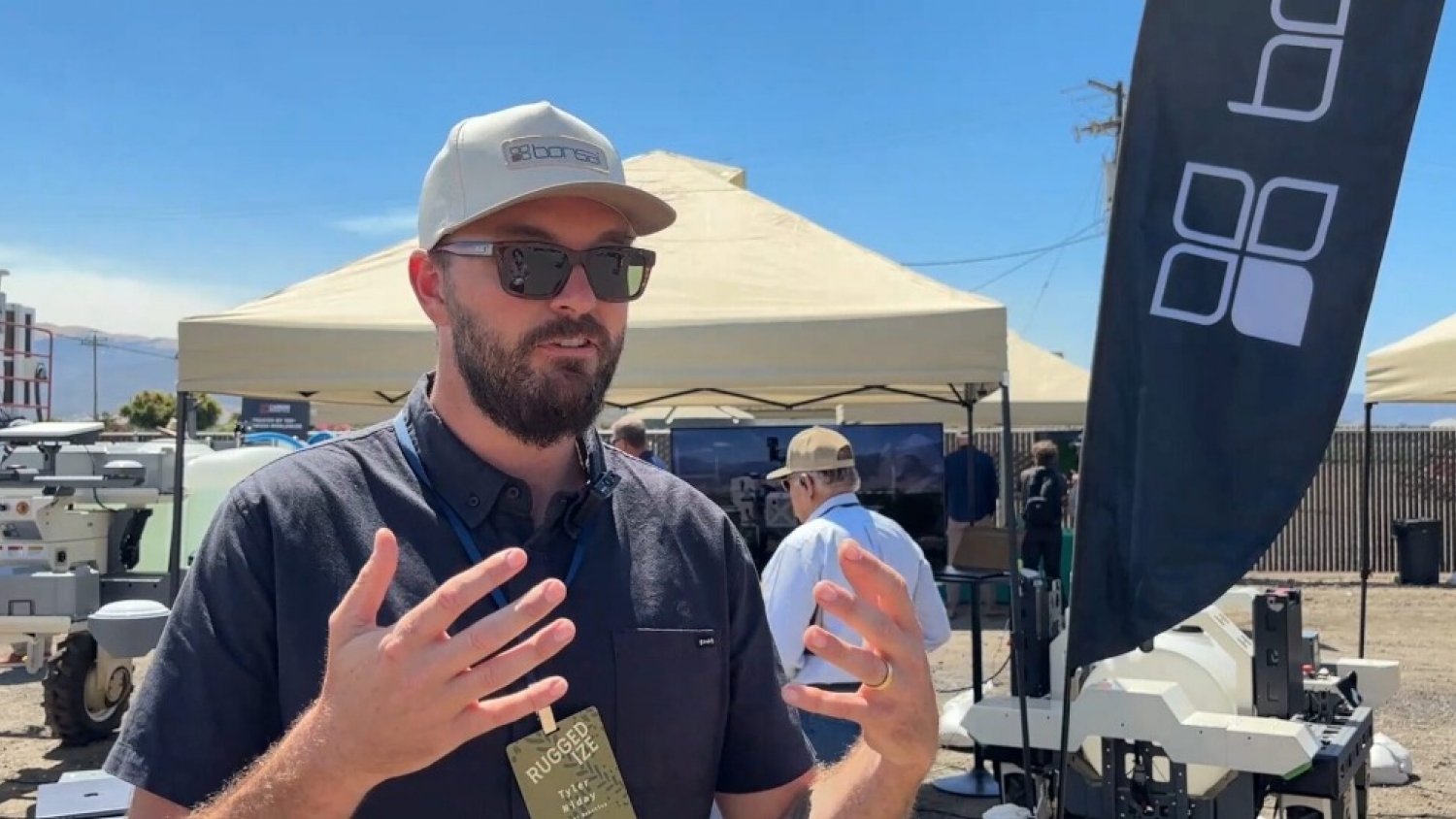
“We’re not just capturing the labor savings from autonomy. We’re additionally reducing the capex, the cost of the machine, and the operating expenses,” Bonsai Robotics cofounder and CEO Tyler Niday told AgFunderNews.
One example illustrates the potential savings. Niday said one of the company’s machines can consume approximately three gallons of diesel per day compared with around 30 gallons for larger conventional equipment used for similar applications.
At the center of Bonsai’s technology is a machine-learning model capable of interpreting a farm environment from standard camera imagery. Instead of relying exclusively on thousands of programmed rules for each crop and situation, the system learns spatial relationships such as elevation, tree locations, ground surfaces, people and machinery.
The technology converts a 2D camera image into a three-dimensional representation of the surrounding environment. This allows an autonomous vehicle to understand where objects are located and navigate through different farming conditions.
Bonsai has deployed more than 400 units and accumulated data from roughly one million acres of specialty crops. The company has also trained an Nvidia world model using agricultural data to simulate environments, crops and changing conditions.
That training becomes especially relevant in difficult agricultural environments.
Traditional autonomous systems can struggle when GPS signals are weak or when dust interferes with sensors such as lidar. Bonsai says its learned vision model can use contextual information to estimate what surrounds a machine even in conditions where conventional sensing technologies may become less effective.
The company initially developed much of its technology in almond orchards, including challenging environments in Australia, but has since expanded its approach.
Its system can now be applied to strawberries, vineyards, apples, table grapes, citrus and other specialty crops. These markets are particularly attractive for robotics because many specialty crops remain highly dependent on labor.
Bonsai follows two commercial paths. It retrofits existing agricultural equipment with its autonomy technology while also selling its own Amiga machines. Niday said revenue is currently divided approximately equally between both models.
Demand for its newer equipment has also accelerated. The company has sold more than 400 units overall, including around 75 OEM retrofit systems, while the rest are Amiga machines. Its new hybrid-electric Amiga Max platform sold out its available production for the year, according to Niday.
Flexibility is central to the economics of the technology. Agricultural machinery can represent a large investment despite being used for only part of the year. Bonsai’s strategy is to turn autonomous platforms into equipment capable of performing several different jobs rather than remaining tied to a single seasonal task.
“You need to go past just a labor replacement and find other ways to drop the cost of these machines and services,” Niday said.
The company also sees artificial intelligence opening opportunities that were considered technically difficult only a few years ago. Niday pointed to robotic harvesting as an example, arguing that advances in end-to-end AI models and physical artificial intelligence are making previously complex applications more achievable.
For agricultural producers, the broader promise is a new generation of machinery that combines automation, lower operating costs and greater versatility. Instead of developing a robot for every crop and task, Bonsai is betting that a common AI foundation can make autonomous equipment useful across a much larger portion of specialty agriculture.
Invertí en periodismo de calidad
En Agroempresario trabajamos para acercarte contenidos que agregan valor.